Faster code does not remove the delivery constraint
AI can shorten research, authoring, and coding tasks inside one repository. A consequential enterprise change still begins with two questions: How long will it take? What will it touch? After the work, a third follows: Can we reconstruct what happened, the evidence used, and who authorised it?
Those answers rarely live in one place. System relationships may sit in people's heads, documentation may lag the software, and approval rationale may be scattered across meetings, chat, tickets, and spreadsheets. A coding agent can produce a locally plausible change while remaining blind to a contract, data flow, operational dependency, or rule beyond its immediate context.
The constraint has therefore moved beyond producing code. It is understanding the surrounding system, carrying that context into engineering work, and preserving accountable decisions through delivery. AIDLC — the AI-Driven Development Lifecycle — is the operating model MSOCK uses to address that wider problem.
One system, three responsibilities
The three product areas are connected by one change, but each has a distinct responsibility.
| Product area | The question it helps answer | Responsibility |
|---|---|---|
| SOCK | What might this change touch? | Build a bounded, connected, evidence-backed view of the software in scope and keep gaps visible |
| SOCI Cockpit | How should the change be engineered? | Apply selected knowledge and reusable lifecycle guidance in a real agent-backed engineering session |
| SOCM Command Center | How was the work allowed to proceed? | Carry lifecycle state, artefacts, named review responsibility, and gate decisions with the work |
Together they form a practical loop: knowledge informs engineering; governed delivery records what progressed and why; changes to the estate can then become the source boundary for the next knowledge version. The current product uses explicit selections and hand-offs at important boundaries—it does not imply that every artefact synchronises automatically.
Knowledge, discipline, execution, and collaboration
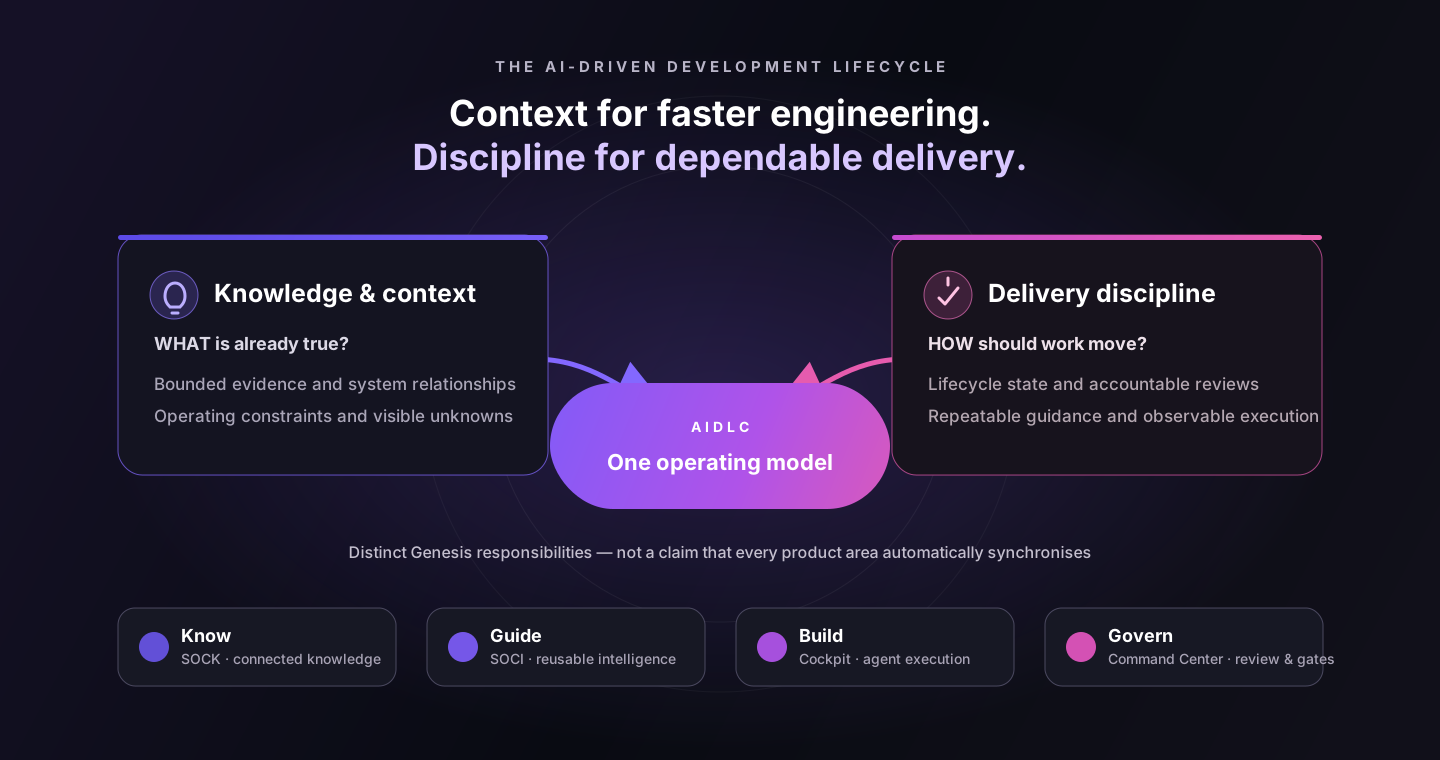
AIDLC treats trustworthy context and delivery discipline as complementary. MSOCK applies this model through SOCK for knowledge, organ packs for shared commands, SOCI Cockpit for agent-assisted work, and SOCM Command Center for governance. The diagram is conceptual, not an integration or availability map.
| Element | Question it answers | How MSOCK addresses it |
|---|---|---|
| Knowledge | What does the captured system and its evidence tell us? | SOCK creates bounded, versioned, evidence-linked knowledge and keeps unsupported conclusions visible |
| Discipline | How should work move, and where must accountable people decide? | SOCM Command Center represents lifecycle stages, ownership, required artefacts, and formal review gates |
| Execution | Where does AI-assisted engineering work actually run? | SOCI Cockpit exposes a persistent terminal-backed coding-agent process through transcript and terminal views |
| Reusable guidance | How can organisational method be distributed consistently? | A versioned organ pack of lifecycle commands is published to each workspace and installed on each member machine |
| Collaboration and visibility | How can participants see state, responsibility, and decisions? | SOCM Command Center gives workspace members a shared view of work and gate decisions across the lifecycle |
Why different stakeholders care
| Stakeholder | Typical concern | Relevant MSOCK outcome |
|---|---|---|
| Engineering leader | Delivery is accelerating, but context, ownership, and review discipline are inconsistent | Visible lifecycle state, explicit gates, bounded knowledge, and recoverable execution |
| Architect or modernisation lead | The estate is poorly understood and a proposed change may affect hidden dependencies | Evidence-backed system understanding, a connected estate graph, and dependency-blast-radius review |
| Engineer | Starting work requires reconstructing context and moving between disconnected tools | A bounded knowledge source, a persistent agent workspace, and a clear work lifecycle |
| Product manager | Intent, artefacts, delivery state, and approval responsibility can drift apart | Work-item visibility and formal review points from early definition through release |
| QA, security, or reviewer | Evidence and accountability arrive late or are difficult to reconstruct | Named gate requirements, review ownership, cited knowledge, and visible unknowns |
| Platform or transformation team | Teams need common guidance without erasing project-specific context | Per-workspace feature control and a versioned organ pack published to each workspace |
Start with one consequential change
The clearest way to evaluate MSOCK is to follow one real change rather than discuss AI capability in the abstract:
1. Name the business or operational outcome and the software scope believed to be involved. 2. Build a bounded view of the relevant repositories, data sources, documents, and available human context. 3. Inspect relationships, evidence, and Known Unknowns before treating the impact as understood. 4. Carry the selected knowledge into the engineering session and use the lifecycle guidance appropriate to the task. 5. Keep artefacts, review responsibility, and gate decisions attached to the work as it progresses.
This does not promise perfect impact prediction or automatic approval. It creates a more inspectable path from intent, through system evidence and engineering work, to an accountable decision record.
The trust model matters as much as the output
- Bounded: claims are relative to declared sources, roles, features, and lifecycle state.
- Versioned: source sets and published knowledge retain an identifiable version or point in time.
- Evidence-linked: consequential SOCK knowledge can be inspected through facts, citations, tiers, and status.
- Gap-aware: missing evidence and Known Unknowns remain visible instead of becoming fabricated certainty.
- Human-governed: formal Command Center gates retain accountable review decisions, and irreversible SOCK actions ask for explicit consent first.
- Recoverable: long-running work resumes from durable state on disk instead of relying only on a transient conversation.
MSOCK therefore does not promise to know everything or remove human accountability. Its value depends on making the available evidence, operating boundary, execution state, and review responsibility easier to inspect.
What this explanation does not claim
- That MSOCK automatically integrates every engineering tool or synchronises every artefact.
- That a SOCK harness represents complete enterprise knowledge.
- That inferred knowledge has the same status as deterministic or directly observed evidence.
- That gates guarantee software quality, compliance, or release safety without competent reviewers.
- That MSOCK currently provides a supported public REST API, SDK, plugin, or connector-extension surface.